
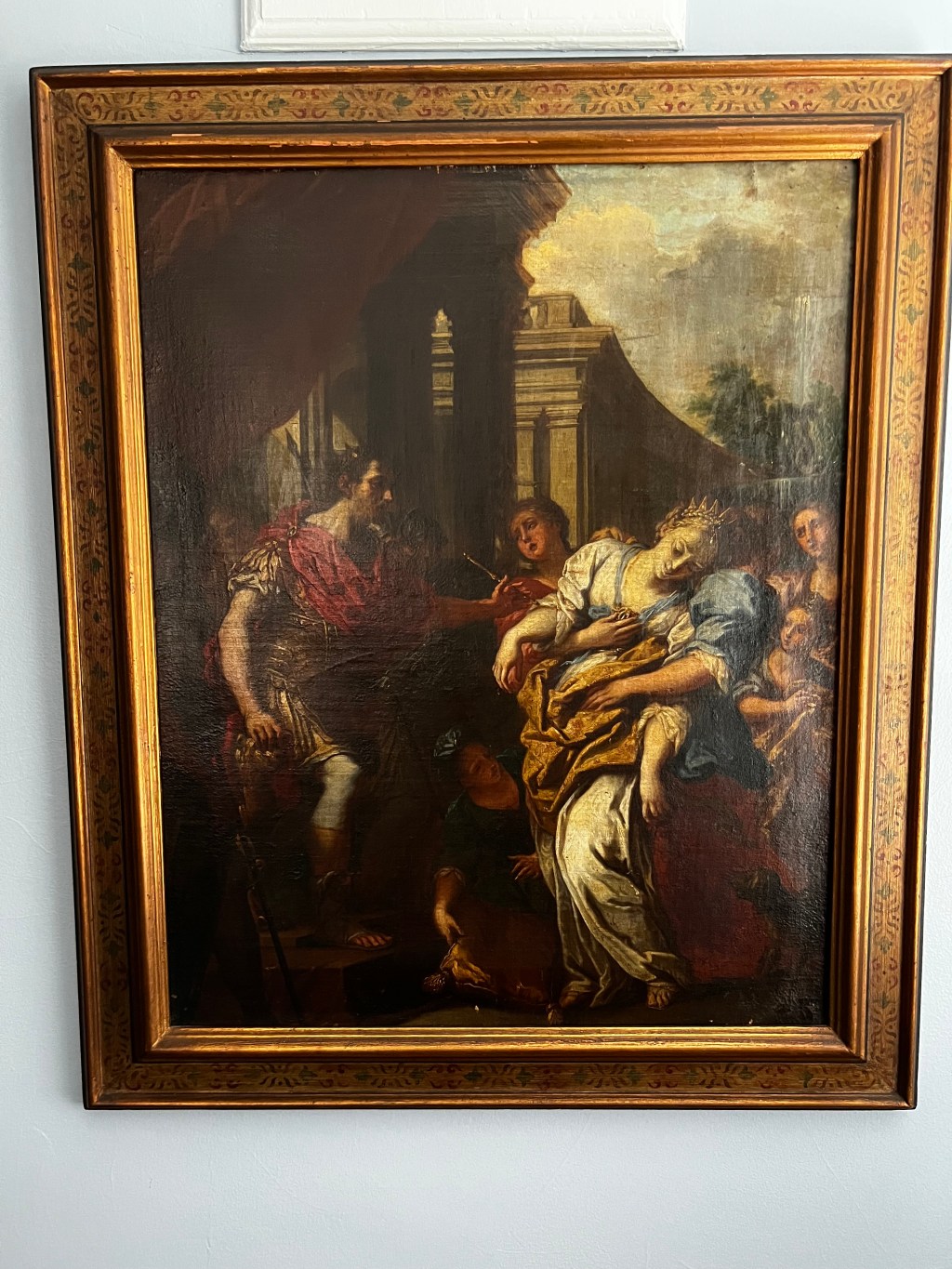
Blog 2: Who painted Esther and Ahasuerus?
This painting is quite the mystery. Read on to discover five theories on who the painter might be. Follow along as I “debunk” a few and argue for two possibilities, in particular! I’ll present my evidence and you let me know who you think it is in the comments!
First, if you haven’t, please go read the first blog: all the facts. In this blog, I bring you up to speed on the mystery of the painting. I present evidence and all the “facts” I know about the painting’s provenance and history. As a general recap, most scholars that have examined the painting believe it to belong to the Venetian or Roman school of Italian painters from between 1660 and 1720. There are ample examples of artists that it could belong to. However, we’ve uncovered some clues that started our search off towards the following potential artists.
- Paolo Caliari (Paolo Veronese) (1528-1588)
Veronese was a Venetian painter, who died in 1588, almost a century prior to the suggested dates of our Esther. First, we are not 100% sure of the date of our Esther. However, even a date of 1588 is very unlikely based on style. It most likely belongs to the 1660’s era of Baroque Italian style. The biggest, and perhaps only, suggestion that it might be by Veronese is the graphite inscription on the stretcher that was recently uncovered with Ultraviolet light. [1] It could be in the school of Veronese, a pupil of his or a student copying his works and eventually got mislabeled. However, it is pretty unlikely that it was painted by him. It is more likely that some in the 18th or 19th century thought it was by him or wanted to sell it as a Veronese and inscribed the name on the stretcher.
One potential theory is that the painting was credited to Veronese, even if it was not actually painted by him. In this case, it would have been archived as such. In 1920, James Mahoney’s sister, Nellie Maria Mahoney, published extracts from his 1911 report, which noted that an Esther and Ahasuerus by Veronese was hung in The Brimmer School on Common Street in Boston, MA.[2] The Brimmer school was established in 1843.
Could the painting in the Brimmer school be our painting? This could be true whether or not it was actually painted by Veronese.
Veronese’s most famous scene featuring Esther is in the Louvre. (figure below)
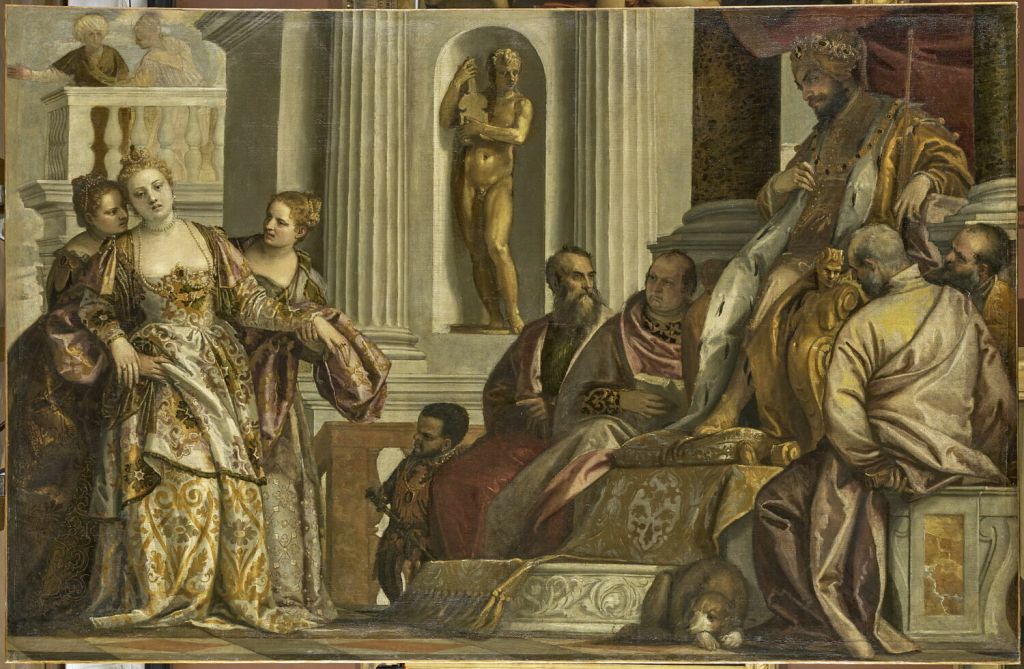
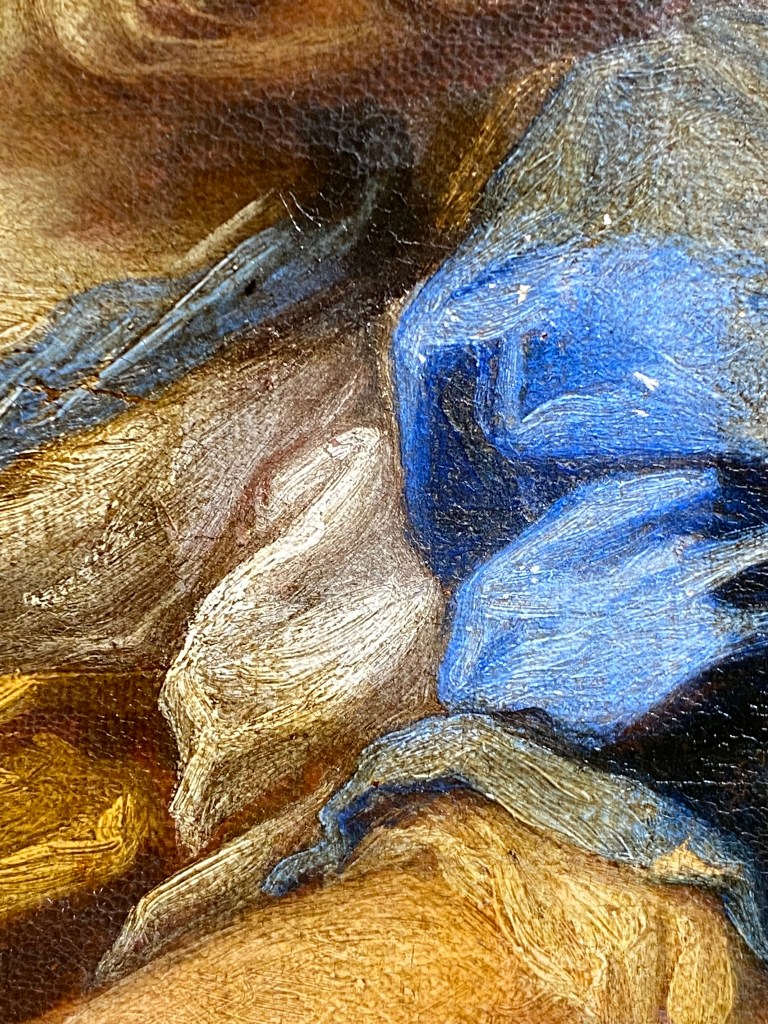
Color wise, our Esther painting does contain a beautiful Venetian blue, which promises to pop when it is fully cleaned. Here is the cleaning test (figure below). Veronese, being from Venice, used this beautiful tone of blue frequently in his works. One thing missing from our Esther, which might have indicated Veronese as the painter, is the Venetian green, which Veronese frequently used. However, the Venetian green is lacking from the painting.
2. Domenico Zampieri or Domenichino (1581-1641)
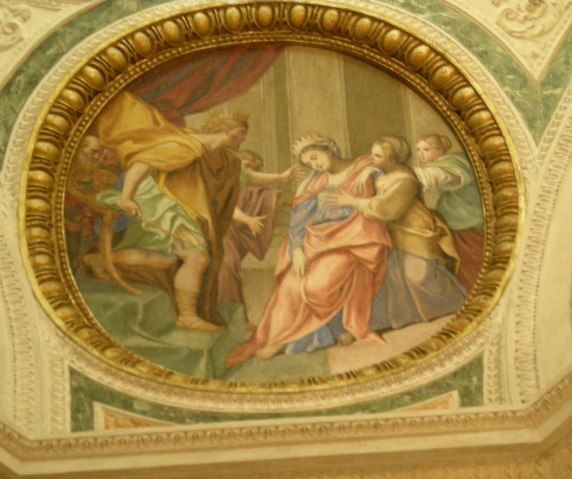
The closest compositionally to our Esther is a fresco by Domenico Zampieri, better known as Domenichino. Around 1628, Domenichino was commissioned to paint frescos in the church San Silvestro al Quirinale in Rome. In the Cappella Bandini he painted four ovals. The four subjects of these ovals are David with a harp, Judith with the head of Holofernes, Solomon and Bathsheba and Esther before Ahasuerus (figure below). [3] An author, Luigi Serra wrote a monograph of Domenichino’s work in 1909.[4] In it Serra mentioned the oval in Cappella Bandini and in his foot notes comments:
“Nel catalogo dell’ex Pinacotexa Manfrin a Venezia (1872, p. 14) e notato un Episodio della Storia di Ester e di Assuerro con parecchie figure intere, bella verduta di colonnati e di giardini nel fondo, attribuito al Domenichino. Non me abbiamo notizia.”[5]
This reference to a piece from the collection of Giovanni Manfrin, which sold in 1872, could reference our canvas. For one, the base description could match our Esther as it contains columns and a small sliver of what some might call a garden in the background. I have as of yet been unable to examine the Pinacotexa catalog from 1872. Perhaps it has more information. Serra notes in 1909, that he has no other reference to the canvas. If this is our Esther, then perhaps it makes sence that references to it were lost and perhaps Dominichino made a small canvas after his fresco or as a “study” for his fresco.
July 8th, 1777, a Domenichino “Queen Esther before Ahasuerus” from the collection of Mr. Alexander Fordyce sold at Mess. Langord as lot 59 on the seventh day’s sale.[6] This may be the same picture that was later in Manfrin’s collection. So, this could be an area of further investigation.
Many later engravers copied his composition. For instance, one engraving by Jakob Frey (1681-1752) in the Wellcome Collection in London features the composition. (figure below) [7] So, many artists would have been exposed to the composition both in the Bandini Chapel and in the engravings that came after. So, regardless of who the artist is, they may have been inspired by Domenichino’s composition.
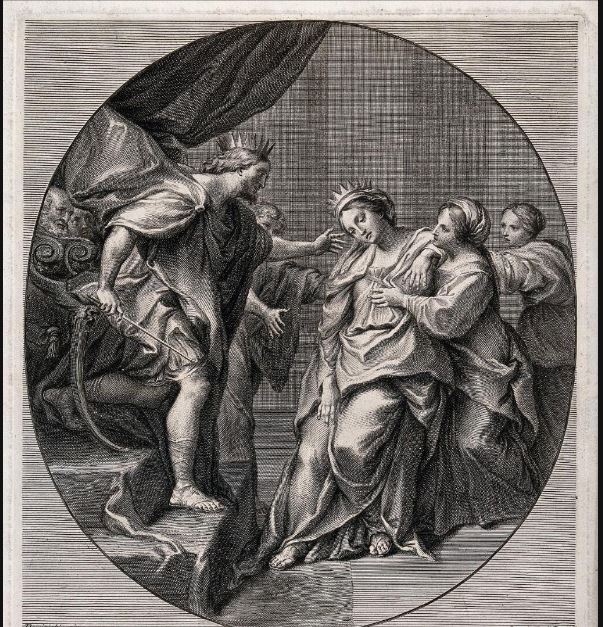
Stylistically, Domenichino’s paintings share very little in common with Esther except for, in this case, the composition. Domenichino was from Bologna, which carries its own unique style that differs from a Venetian or Roman approach. [8]
3. Pietro da Cortona
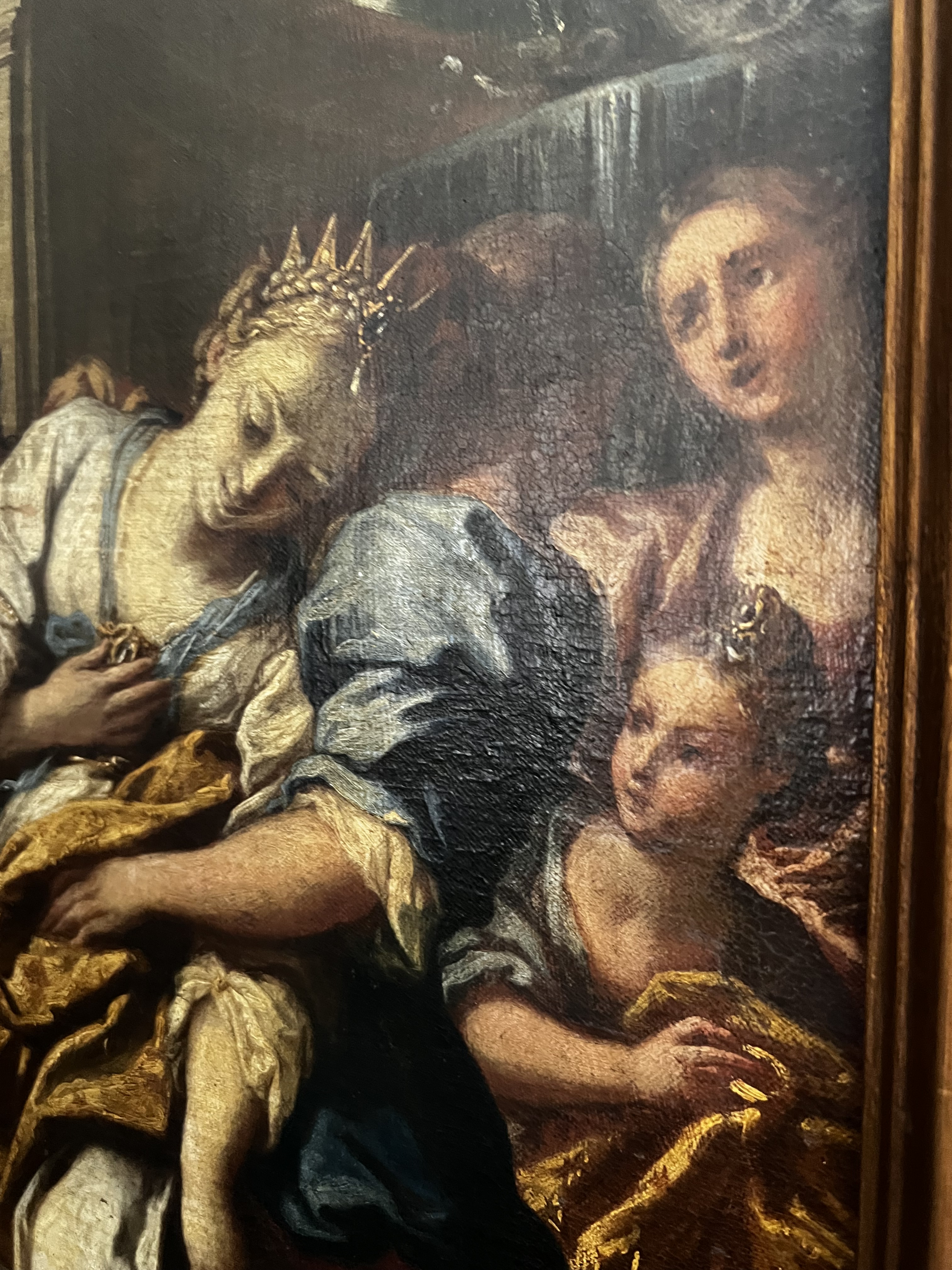
Pietro da Cortona (1596-1669) initially trained in Florence but spent most of his adult career in Rome. Stylistically, our Esther shares a lot with da Cortona’s style and could perhaps belong to the later half of his career. The first hint to Cortona is the note at the bottom of the NGA form 99A which claims it is a follower of Pietro da Cortona. There are many followers of Pietro da Cortona, one in particular which we will examine below, but for a minute let us suppose it was by the master himself or was executed in his studio.
Personally, the painter whose style most closely resembles our paintings is Cortona. Take a look at the comparisons below:
Here the Guardian Angel’s hand shares similarities to Esther in our painting (figure below).[9]
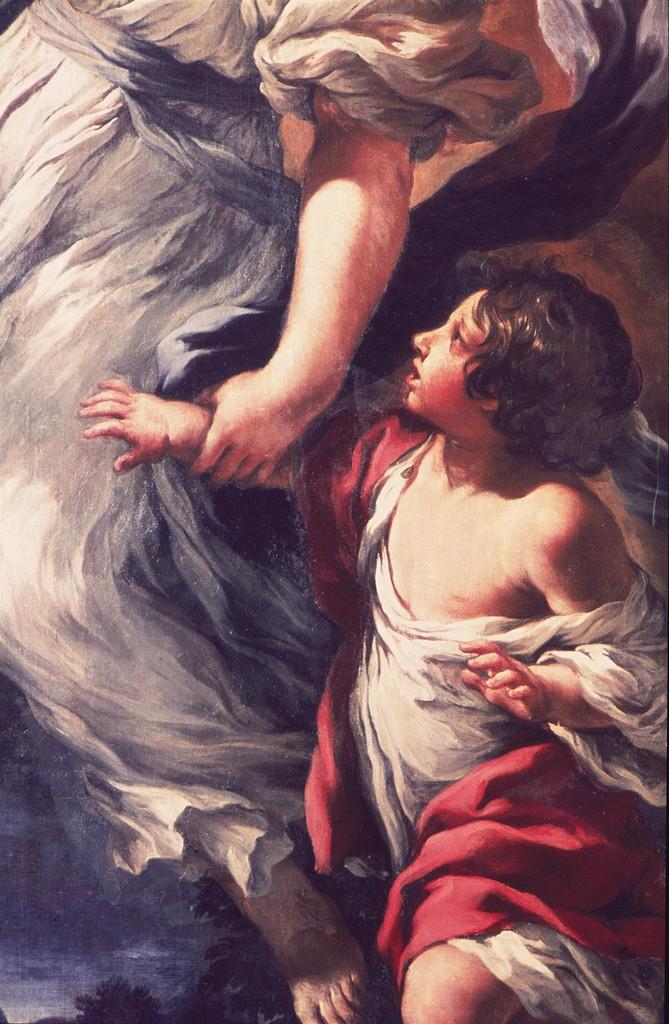
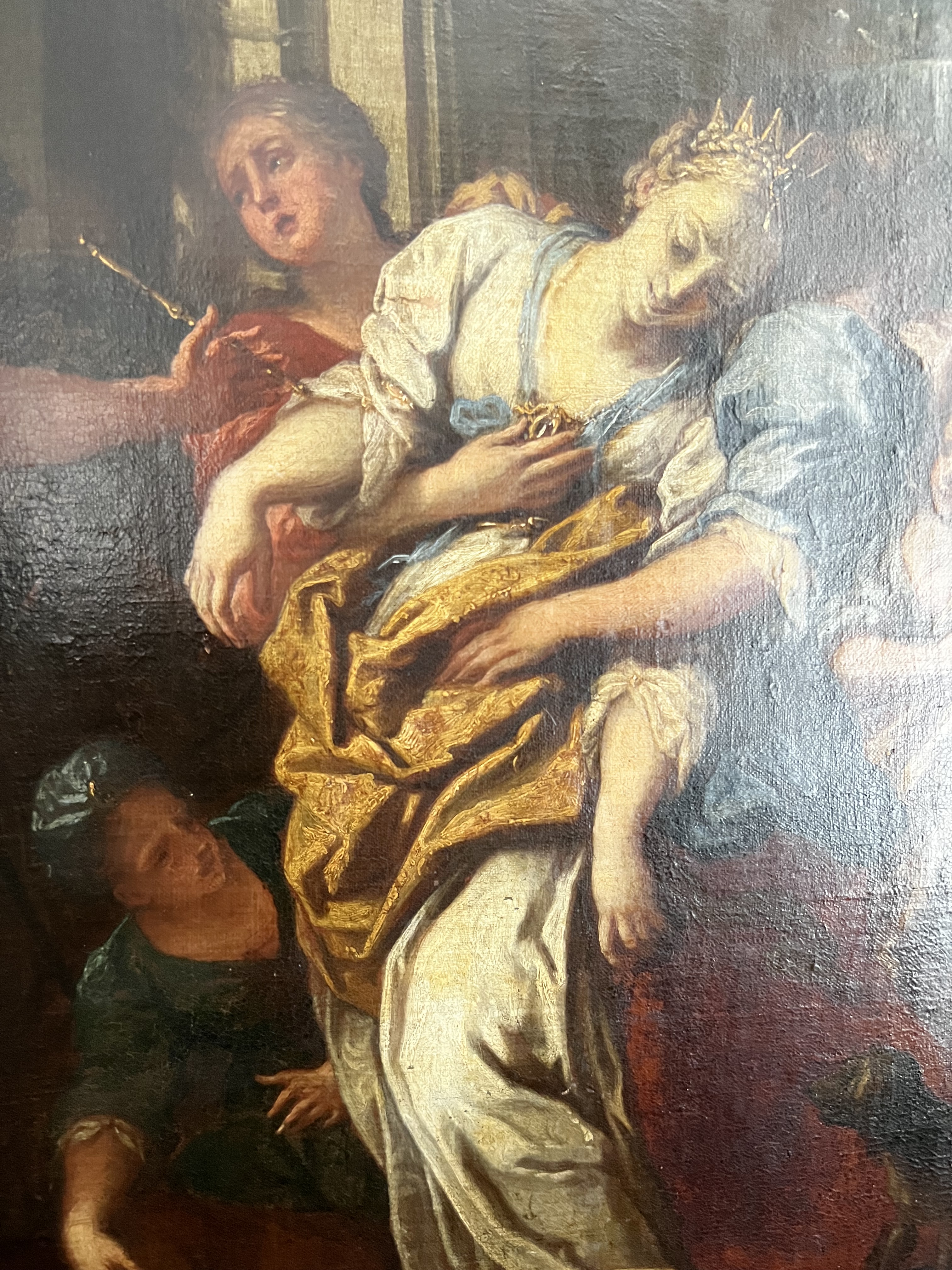
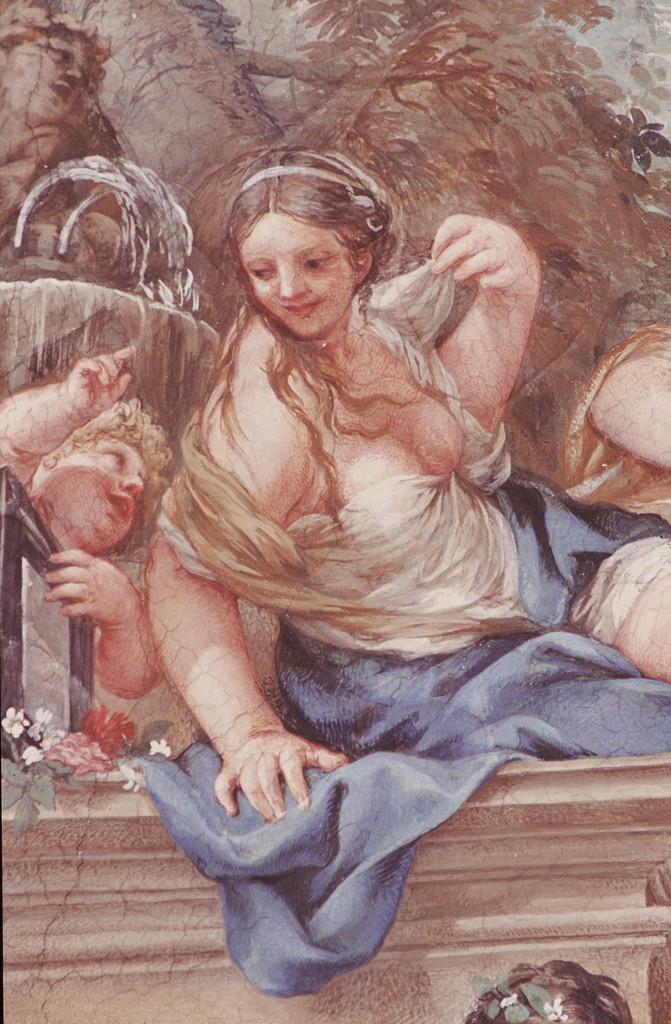
In 1640, Cortona worked on the Palazzo Pitti Frescos with the painter Ciro Ferri (1634-1689), who finished quite a bit of the frescos after Cortona’s departure. In fact, most agreed that Ferri had copied the master’s style so perfectly there could be no distinction as to what section each had taken on.[10] Part of the Sala di Venere ceiling features this detail of a Lady in Blue. (figure below) Behind her, is a waterfall which shares a similar brushwork to the fountain in our Esther.[11]
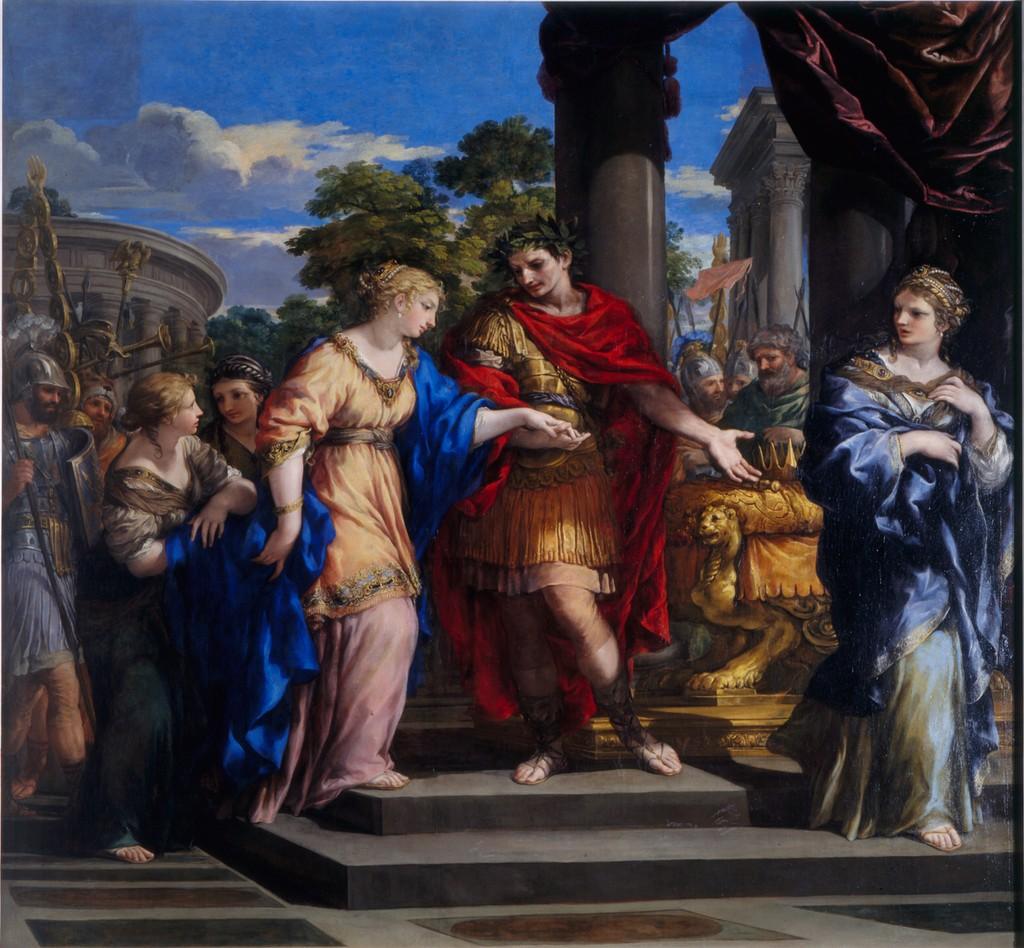
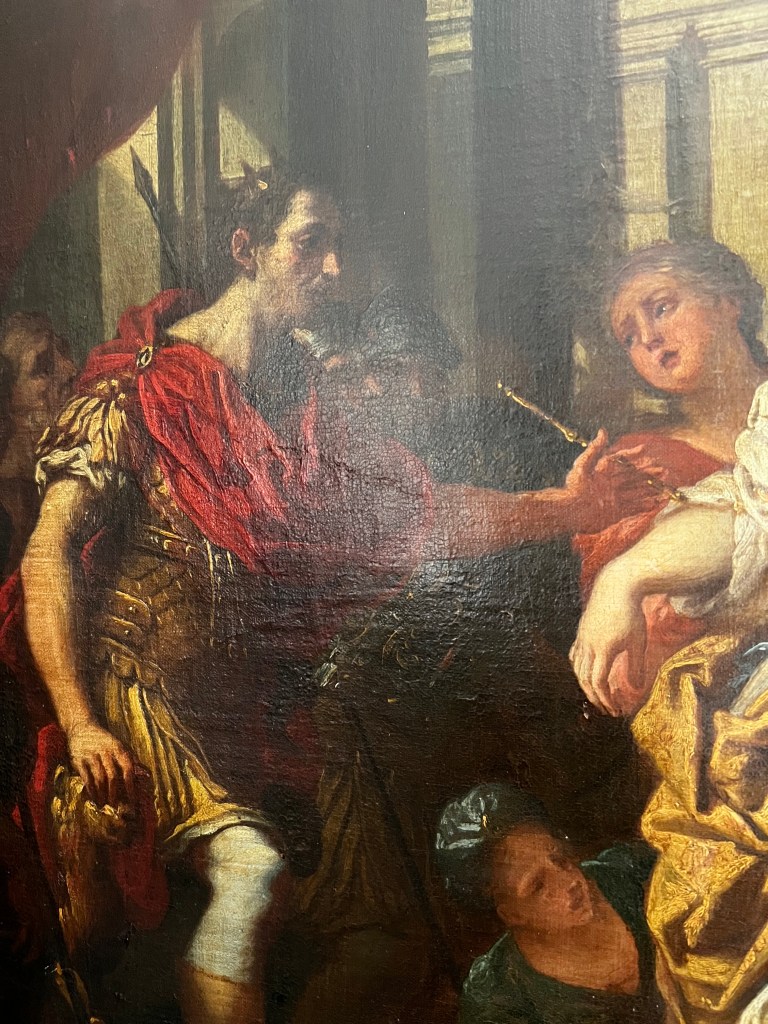
In 1643, Cortona painted Caesar leads Cleopatra to the Throne of Egypt, which shares a lot with our Esther. (figure below) [12] Ahasuerus (the king on the left) and Caesar share the same Roman outfit. The thrones share the same lion headed armrest. Also, in my opinion several other elements of the painting are reminiscent of our Esther. Both Caesar and Cleopatra, and the ceiling of the Pitti Palace might suggest a 1640’s date to our composition.
4. Giovanni Francesco Romanelli (1610-1662)
On NGA form 99-A, art historian Lester Cooke penciled in Romanelli beside the typed “follower of Pietro da Cortona”.[13] Romanelli was an Italian painter from Rome, who started in the studio of Domenichino before eventually training under Cortona. [14] To me, his style is not quite the same as the painting, but he is said to be a very strict follower of Cortona’s style, imitating his style with exactitude.
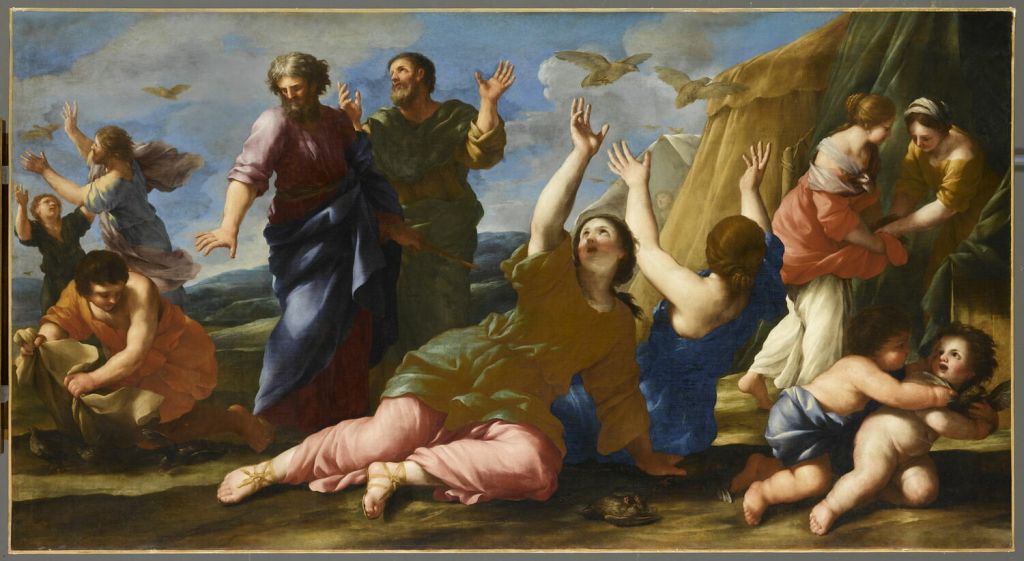
If we examine Le Miracle des cailles, by Romanelli from the Louvre, some of the figures in the background of our painting bear resemblance to Romanelli’s figures from Le Miracle. (figure below) [15]
5. Unknown 18th century artist
Of course, the final potential is that it is someone else from the late 17th or early 18th century operating in these circles.
Other names that have come up in my search include Sebastiano Ricci (1659-1734) a known imitator of Veronese, Raffaelo Vanni (1590-1673), Francesco Cozza (1605-1682) a friend to Domenichino, Luigi Garzi (1638-1721), Carlo Maratti (1625-1713), Luca Giordano (1632-1705) pupil of Cortona and Giovanni Battista Gaulli(1639-1709).[16]
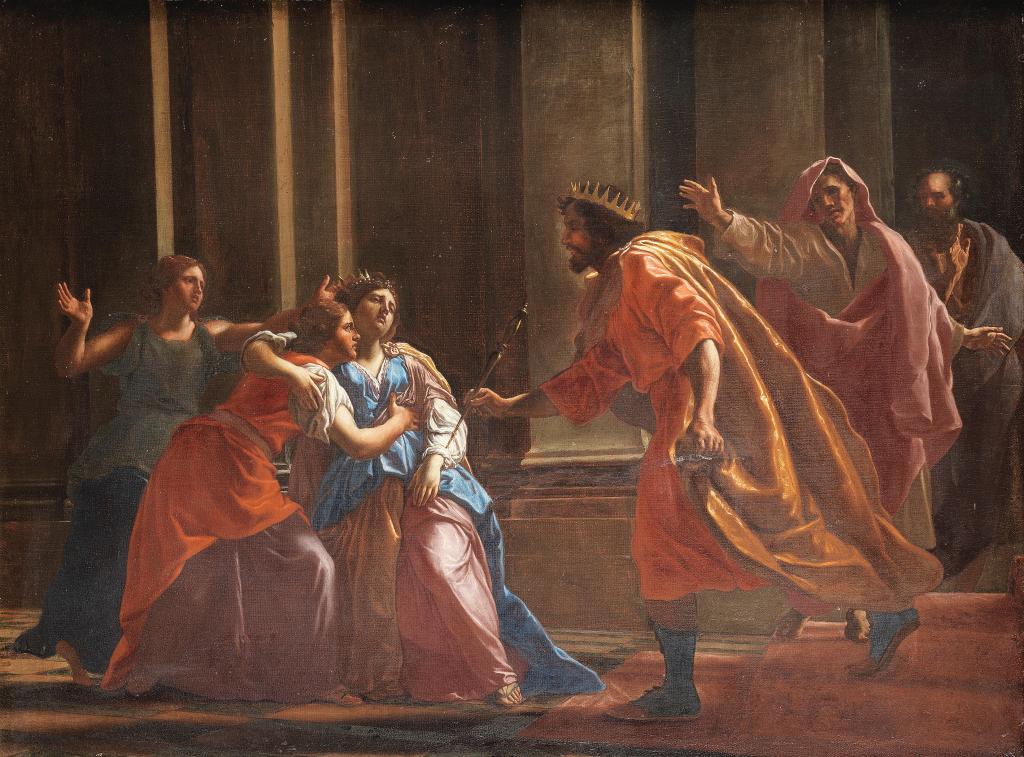
Francesco Cozza sold an Esther fainting before Ahasuerus at Bonhams in July 2020 (figure below).[17]
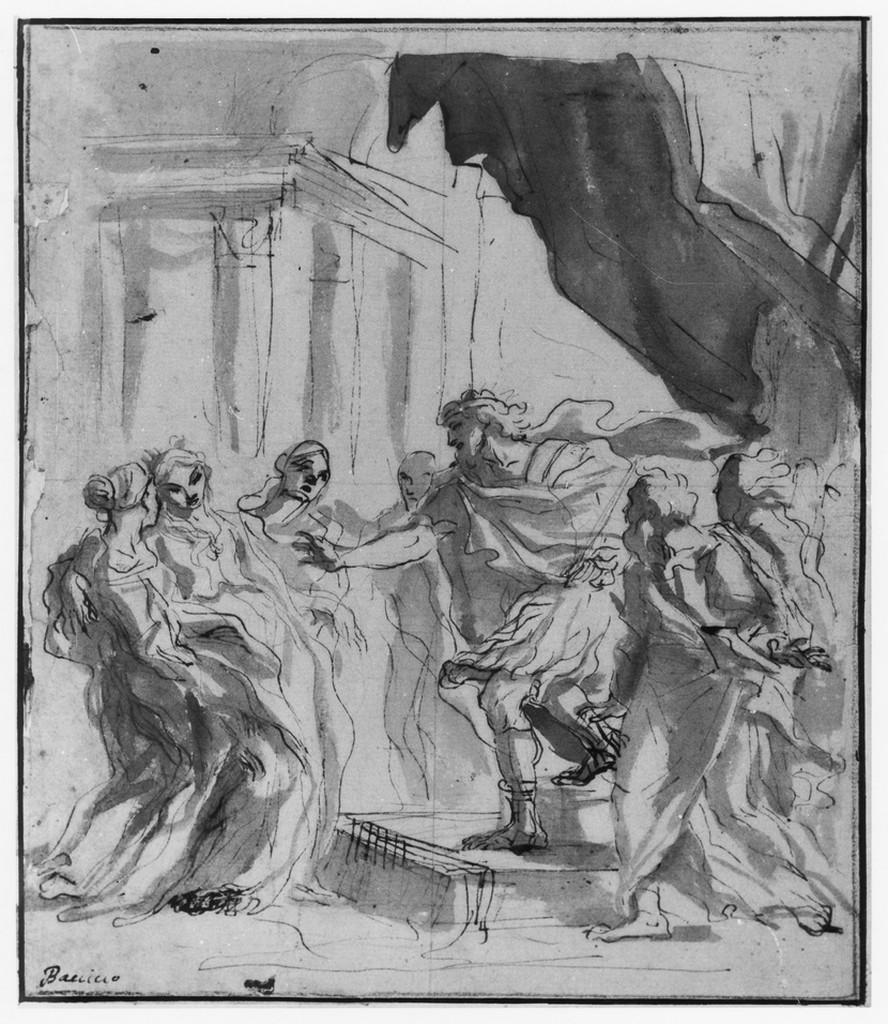
Giovanni Battista Gaulli might be a contender. Known as Baciccio, this painter was actually Genoese. A sketch Gaulli signed shares similarities in composition to Domenichino’s fresco (figure below).[18]
Which of these do you find most convincing? Do you think it was painted by someone else’s hand? Although I hope to one day uncover a reference that links our Esther, without a doubt, to a specific artist, that might never happen. We could have a technical analysis done to specify the date more closely. However, what we are really in need of is expert stylistic analysis from historians specializing in the works of these artists. Know any?
I know I mentioned in the last blog that the subject was, without much doubt, Esther and Ahasuerus. However, coming up next in the Mystery of Esther series will be; Is it really Esther?
Subscribe to find out what is next.
[1] One thing this does hint at is the painting being in England, Northern Europe or perhaps France, but definitely not Italy during the 18th or 19th centuries. This is because the spelling of the name would not have been Paul or even Paol (if that’s what it reads) unless it was outside of Italy and most likely in England. (a hypothesis for those who might want to know, Miss. Grace Billings took a trip to Southampton England sometime between 1930-1950 according to Ancestry)
[2] Mahoney, Nellie Maria. James Mahoney, 1862-1915: Biographical Sketch, Letters of Appreciation, Literary Productions. United States: Privately printed by the Rumford Press, 1920. (249)
[3] Serra, Luigi. Domenico Zampieri detto il Domenichino. Italy: E. Calzone, 1909. (78)
[4] Likely Luigi Serra (1881-1940) an Italian art historian.
[5] Serra, 78.
[6] Alexander Fordyce (about) and Mess. Langford (about)
Art Sales from Early in the Eighteenth Century to Early in the Twentieth Ce… – Google Books
[8] The curators providing their opinion on the work have suggested that the work is Venetian or possibly Roman based on stylistic cues.
[9] Pietro, da Cortona, 1596-1669. Guardian Angel: Det.: Child. n.d. Galleria nazionale d’arte antica (Italy). https://jstor.org/stable/community.13604055.
[10] Brinton, Selwyn. The Renaissance in Italian Art: The Medici at Florence. [Florence, 1908. United Kingdom: n.p., 1908. (137)
[11] Pietro, da Cortona, 1596-1669. Pitti: Sala Di Venere- Ceiling: Det.: Lady in Blue on Balustade to Lt. c.1641. Fresco. Palazzo Pitti. https://jstor.org/stable/community.13612618.
[12] Pietro da Cortona. Caesar Leads Cleopatra to the Throne of Egypt. 1643. Oil on canvas, 255 x 266 cm. Lyon (France). Musée des beaux-arts. https://jstor.org/stable/community.15666283.
[13] If you are confused, go back and read the first post in the blog series: all the Facts.
[14] Wornum, Ralph Nicholson. The Epochs of Painting: A Biographical and Critical Essay on Painting and Painters of All Times and Many Places. United Kingdom: Chapman and Hall, 1864. 347
[15] Le Miracle des cailles – Louvre Collections
[16] Brinton, Selwyn. The Renaissance in Italian Art: The Medici at Florence. [Florence, 1908. United Kingdom: n.p., 1908. (137)
[17] Bonhams : Francesco Cozza (Stilo 1605-1682 Rome) Esther before Ahasuerus
[18] Giovanni Battista Gaulli. Esther before Ahasuerus. c. 1665. Pen and brown ink with brown wash over indications in black chalk on pale buff paper, 25.6 x 21.8 cm. Ashmolean Museum, Oxford, England; Purchased (Old Master Drawings Fund), 1960. https://jstor.org/stable/community.14543877.
 Caroline Haller Curation