
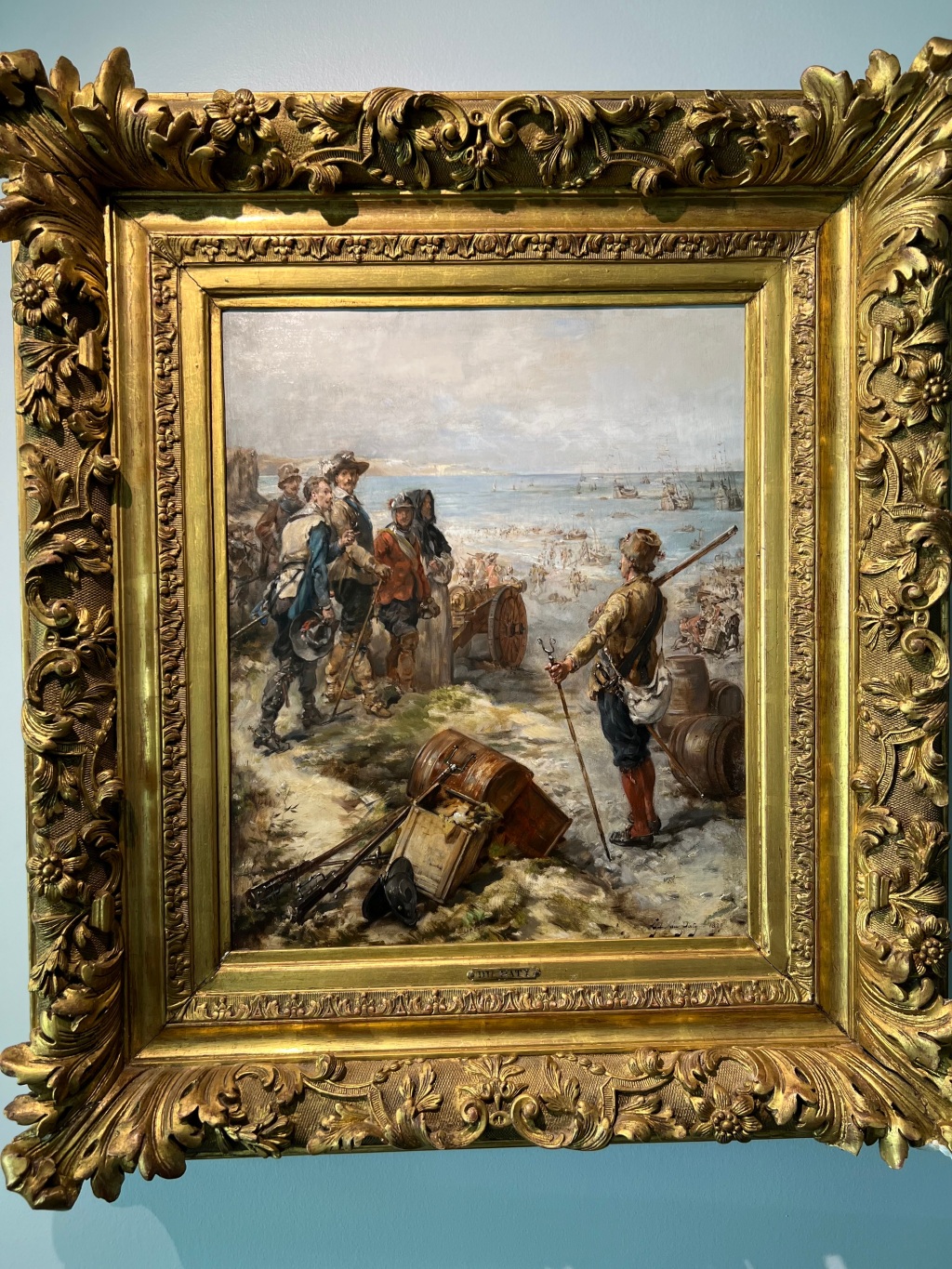
Today I interrupt your regularly scheduled entry in the Mystery of Esther series (more on that here) to bring you another fun piece from our own collection. Purchased at auction in 2019, this beautiful 19th century piece was also somewhat of a mystery.
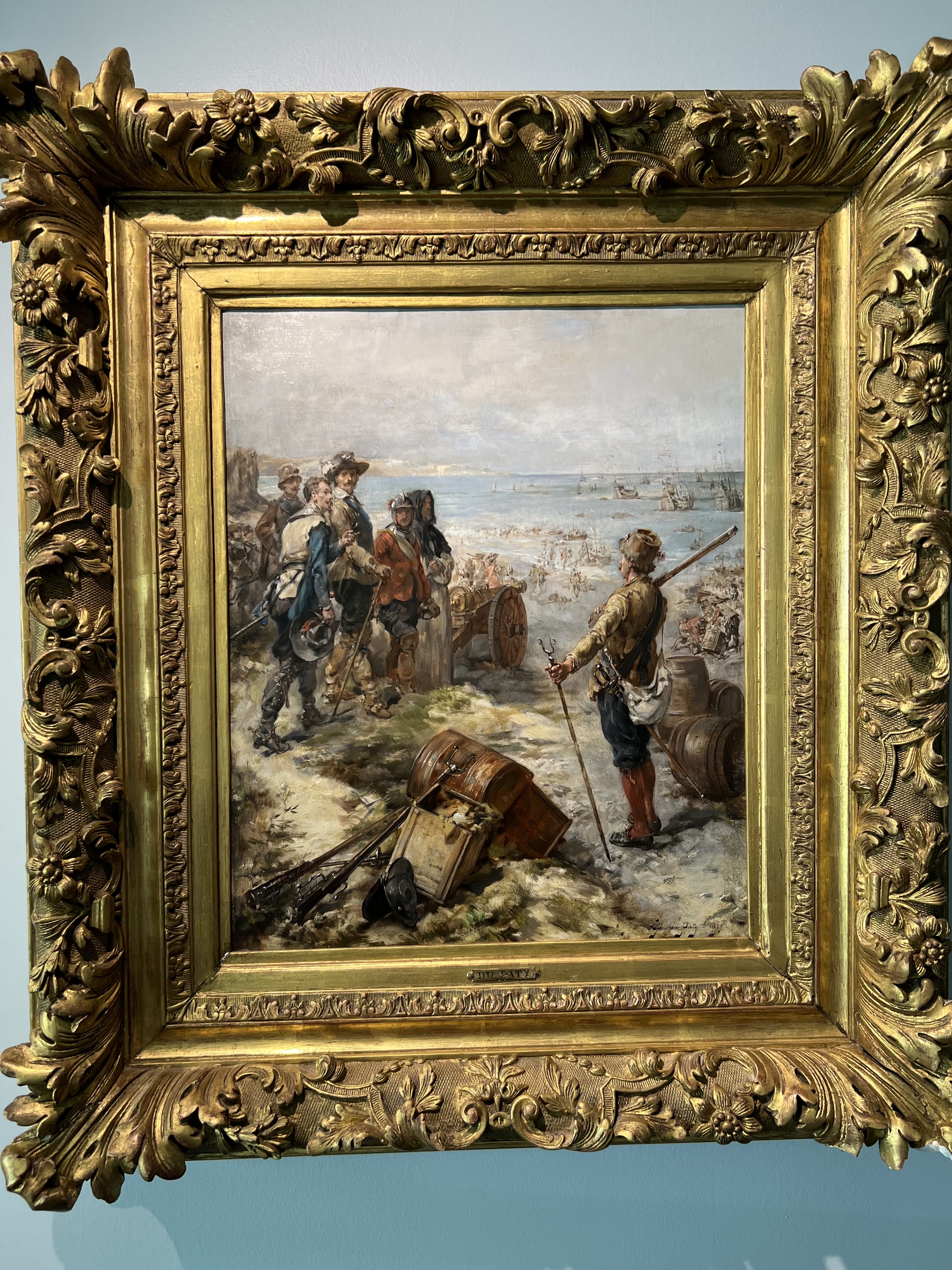
The Artist: Leon du Paty
French artist Leon du Paty was born on November 5th, 1849, and died in 1920 in Paris. Through the 1870’s, Du Paty was particularly active painting scenes of French political history. Du Paty is known for his genre scenes, battle scenes, history paintings and even interiors.
Although currently lesser known, du Paty was well regarded during his time. In fact, in 1869 a report for the pictures and music section wrote about a work by Leon Du Paty, saying that despite his youth and judging his current work “we should call him the hope of the Ecole de Beaux Arts.”[1] By all accounts du Paty was trained at Ecole de Beaux-Arts in Paris. There he studied with the French academic painter Isadore-Alexandre-Augustin Pils (1815-1875).[2]
Du Paty’s known works include The Siege of La Rochelle, Soldados a Caballo[3], The Outpost[4], Mort de la Nymphe Hesperie,[5] a portrait of a lady [6], and this interior scene.[7] Also known is a collaboration between du Paty and Theophile Poilpot (French 1848-1915) a military painter and commander in the Legion of Honor. Together they painted a set of four works depicting La Siege de Paris en 1871.[8]
Most notably, du Paty’s View of Palace Square through the Admiralty Arch sold at Sotheby’s in 2013.[9] This painting features the known palace square in St. Petersburg, Russia. Although the painting was not signed, Sotheby’s inferred a date of post 1876 due to the depiction of the bookseller Wilhelm Leontovich Veidle, who was given imperial appointment that year. Du Paty’s scene offers a particularly candid view into 19th century St. Petersburg.
The same year that du Paty painted our picture, his wife sat for a portrait by du Paty’s contemporary Edouard Manet (1832-1883). Portrait of Mme du Paty was listed at Sotheby’s in 2016.[10] Manet was said to be friends with du Paty and his wife, who it seems was quite the socialite.[11]

L’Embarquement en 1627
Du Paty painted this work, known as L’Embarquement en 1627, in 1879. That year it was exhibited at the Parisian Salon. The oil on cradled board measures 27 ¼” x 24” in its gilt frame, which previous owners claimed to be the original frame. It is signed and dated in the left corner: Leon du Paty 1879.


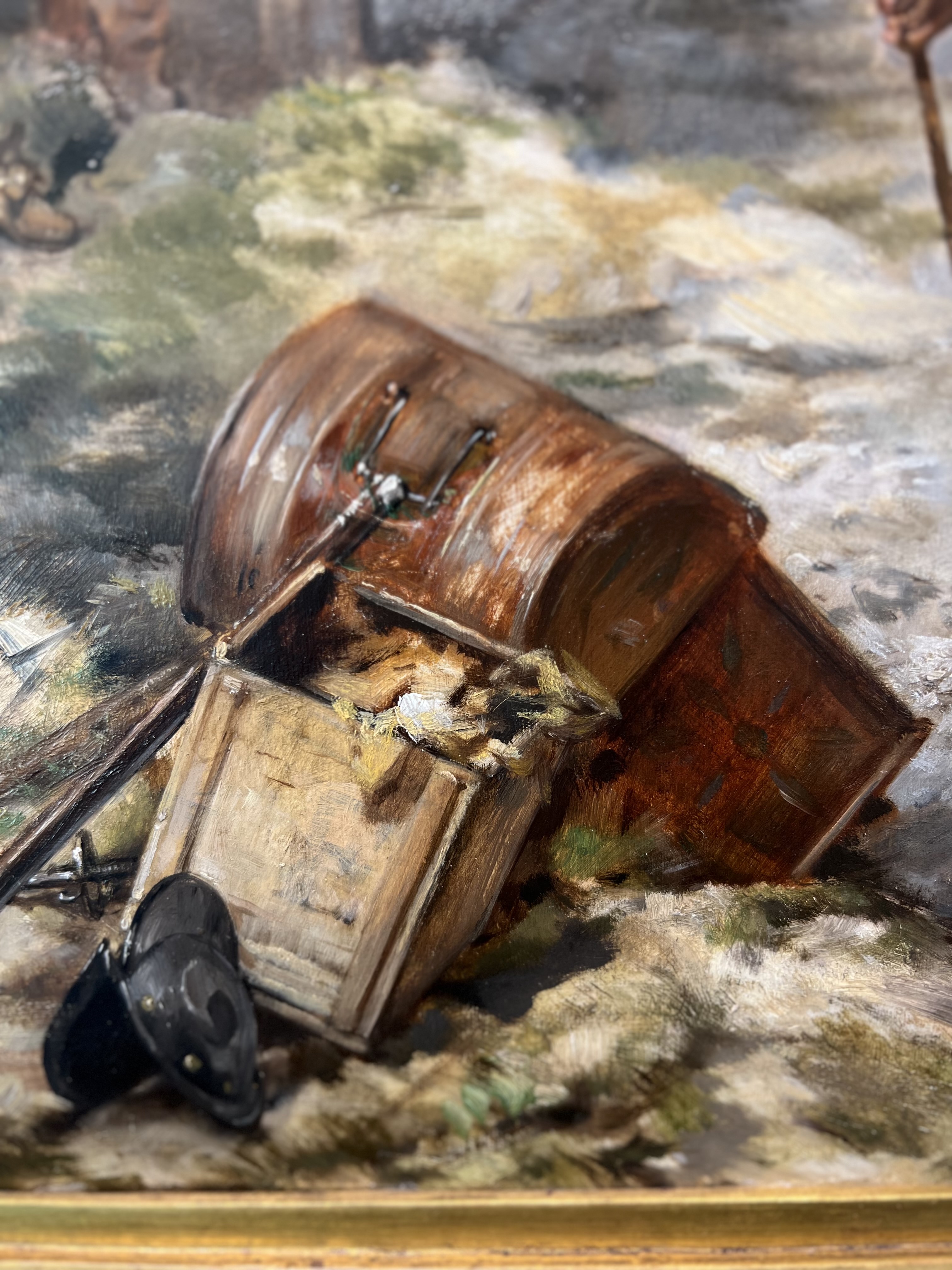

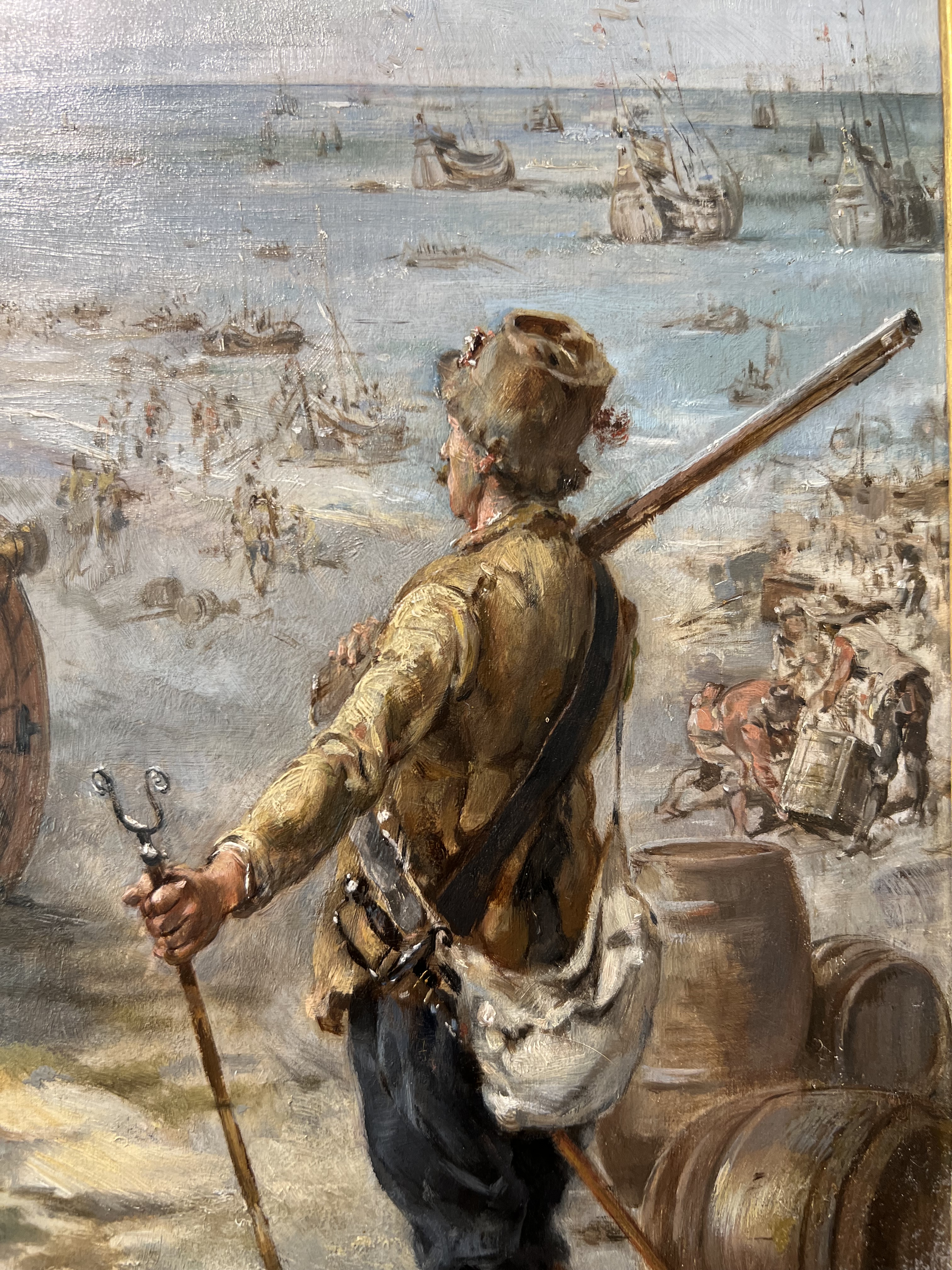
In 1627, a war broke out between French forces under the control of Louis XIII and the Huguenots of La Rochelle. The French siege of La Rochelle resulted in victory for the Catholic king and loss for the Protestants. Now we know that du Paty painted a scene of the battle earlier in 1869.[12] However, given the title, this scene might represent the French troops embarking on a marine battle of some sort, potentially La Rochelle. In fact, the French Régiment de La Marine was founded in 1627.
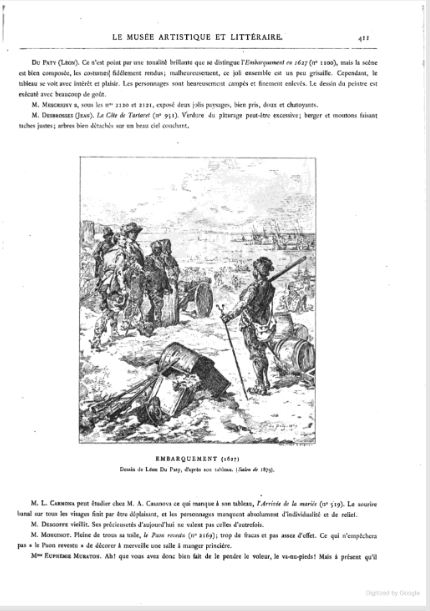
In the first edition of Le Musée artistique et littéraire: revue illustrée, an unknown Parisien critiqued works at the Salon.
The entry about our du Paty reads :
“Ce n’est point par une tonalité brillante que se distingue l’Embarquement en 1627 (n 1100), mais la scène en bien composée, les costumes fidèlement rendus ; malheureusement, ce joli ensemble est un peu grisaille. Cependant, le tableau se voit avec intérêt et plaisir. Les personnages sont heureusement campés et finement enlevés. Le dessin du peintre est exécuté avec beaucoup de gout.”[13]
In other words, while the author was enamored by du Paty’s brilliant tonality and the composition, especially regarding the character groupings, they thought the painting over all a little gray.
We have to remember that this response was taking place at a time prior to acceptance of the modern painting techniques as acceptable practice within the Ecole de Beaux Arts. Although gray was used since the renaissance in art, the use of grey reflects modernity. The use of grey has been established by scholars as representative of modernity for several reasons. For instance, Francis Guerin notes that the use of grey paint represents industrial modernity due to artists trying to replicate the smoke, or smog produced by machines.[14]
Overall, du Paty’s impressive scene was well received at the time and is now relatively unremarkable today due to its adherence with traditional standards of painting. Nonetheless, I find little bit of French modernism peeking through the canvas.
Provenance
Perhaps the typical art historian might stop after this brief synopsis of the artist, subject and period within which the painting fits. I also love the story of provenance. No matter how simple, each painting’s history also includes how the painting got to be where it is and who owned it. So, I’ll include all that I know about its provenance as well. So, that if there are any sleuths in the ranks of readers, and you wish to research yourself, you’ll have all the facts.
1879:
In 1879, our painting was exhibited at the Paris Salon. Numbered as 1100 and titled L’Embarquement en 1627.
At the salon, It is listed as belonging to M. F. Méaulle (1844-1916). Fortuné Louis Méaulle was a wood engraver and writer and he and du Paty work closely together on books and illustrations.
1927:
Meaulle died in 1916, followed shortly by Du Paty in 1920. At some point after the salon the painting made its way into the hands of American collector and industrialist Charles Albert Gould (1849-1926). In 1927, Gould passed away and the painting was sold in Gould’s estate in 1932 through Anderson Galleries. It was referred to as the Battle Scene.[15]
1943:
In 1943, the painting was sold as no. 66 The Embarquement through Parke-Bernet Galleries.[16] At some point prior to when I acquired the work, it was part of the Peter Tillou’s Collection. Peter Tillou (about) and
Peter’s son Jeffery Tillou now runs Jeffery Tillou Antiques shop out of Litchfield Connecticut and sold the work at some point prior to the Cottone Auction sale listed below.
Leon Du Paty • Jeffrey Tillou Antiques
2019:
On September 29th, 2019, the painting was purchased by my family from Cottone Auctions in NY. Now referred to as “The Landing,” it’s a must view work!
Leon Du Paty (French, 19th Century) “The Landing” | Cottone Auctions
[1] The Musical Standard. United Kingdom: Volume XI. July 3 – December 25, 1869, p.99.
[2] Explication des ouvrages de peinture, sculpture, architecture et gravure de… – Google Books
[3] Soldados a caballo by Leon Du Paty on artnet
[4] THE OUTPOST by Leon Du Paty on artnet
[5] Explication des ouvrages de peinture, sculpture, architecture et gravure de… – Google Books
[6] Catalogue illustré du Salon… / publié sous la direction de F.-G. Dumas | 1879 | Gallica (bnf.fr)
[7] Bidspirit auction | LEON DU PATY (1849-1920), INTERIOR
[8] 19th Century European Paintings, Drawings and Sculpture. United States: Sotheby’s, 1992.
[9] (#116) Leon Du Paty (sothebys.com)
[10] (#409) Édouard Manet (sothebys.com)
[11] According to Adolphe Tabarant, she was close to the Manet family (Adolphe Tabarant, op. cit., p. 368). Moreau-Nélaton reports that she was “une mondaine à qui l’on prête quelques aventures” (Etienne Moreau-Nélaton, op. cit., p. 68).
[12] Catalogue illustré du Salon… / publié sous la direction de F.-G. Dumas | 1879 | Gallica (bnf.fr)
[13] Le Musée artistique et littéraire: revue illustrée. N.p.: Librairie de l’art, J. Rouam, éditeur, 1879. (411) Le Musée artistique et littéraire – Google Books
[14] Guerin, Frances. The Truth Is Always Grey: A History of Modernist Painting. United States: University of Minnesota Press, 2018. The Truth Is Always Grey – Google Books
[15] The Charles W. Gould art collection : American Art Association : Free Download, Borrow, and Streaming : Internet Archive
[16] Sales. Vol 507-521. United States: Parke-Bernet Galleries, 1943. p.10 https://www.google.com/books/edition/Sales/VJDpAAAAMAAJ?hl=en&gbpv=1&bsq=leon+du+paty&dq=leon+du+paty&printsec=frontcover
 Caroline Haller Curation