
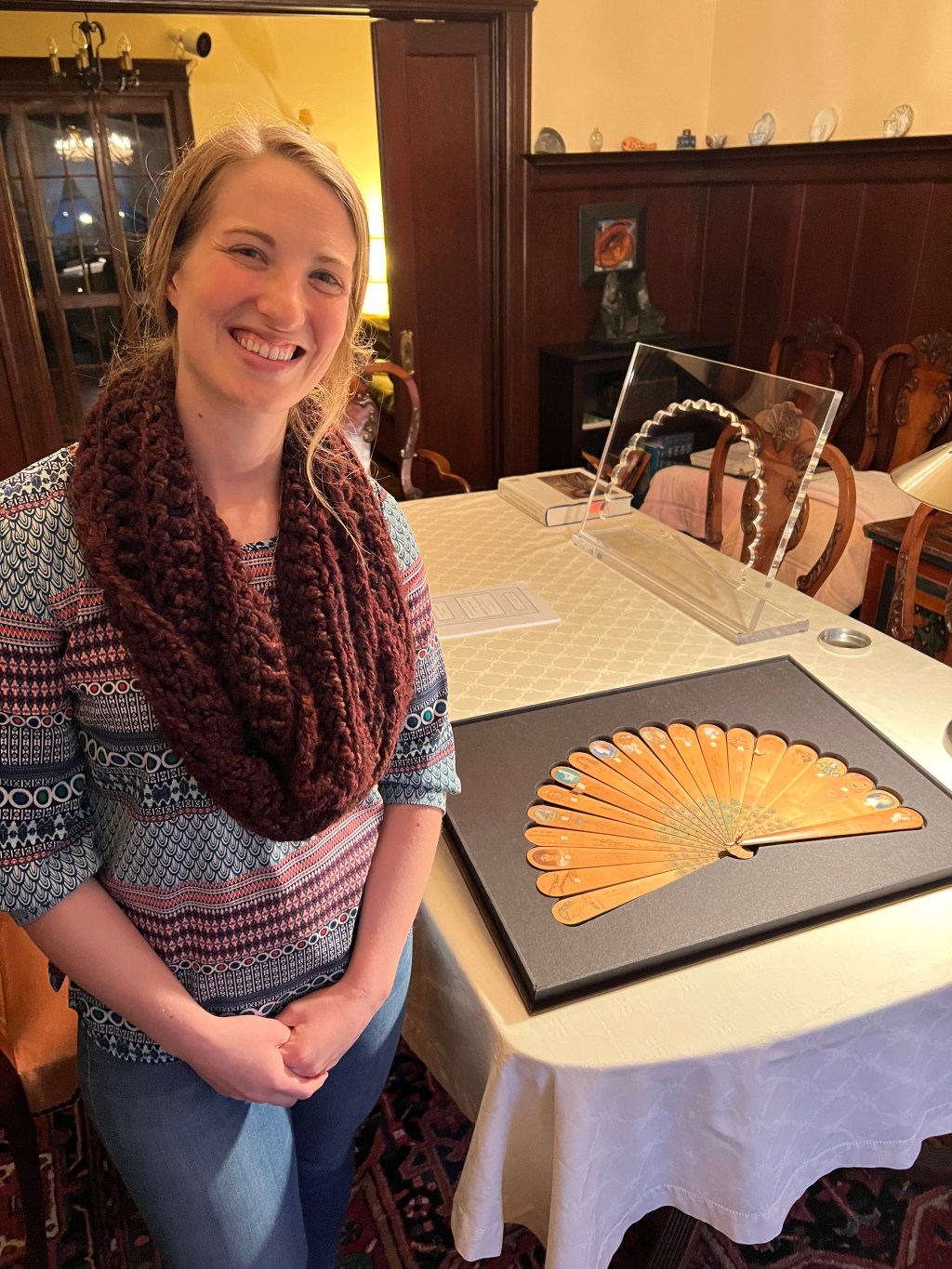
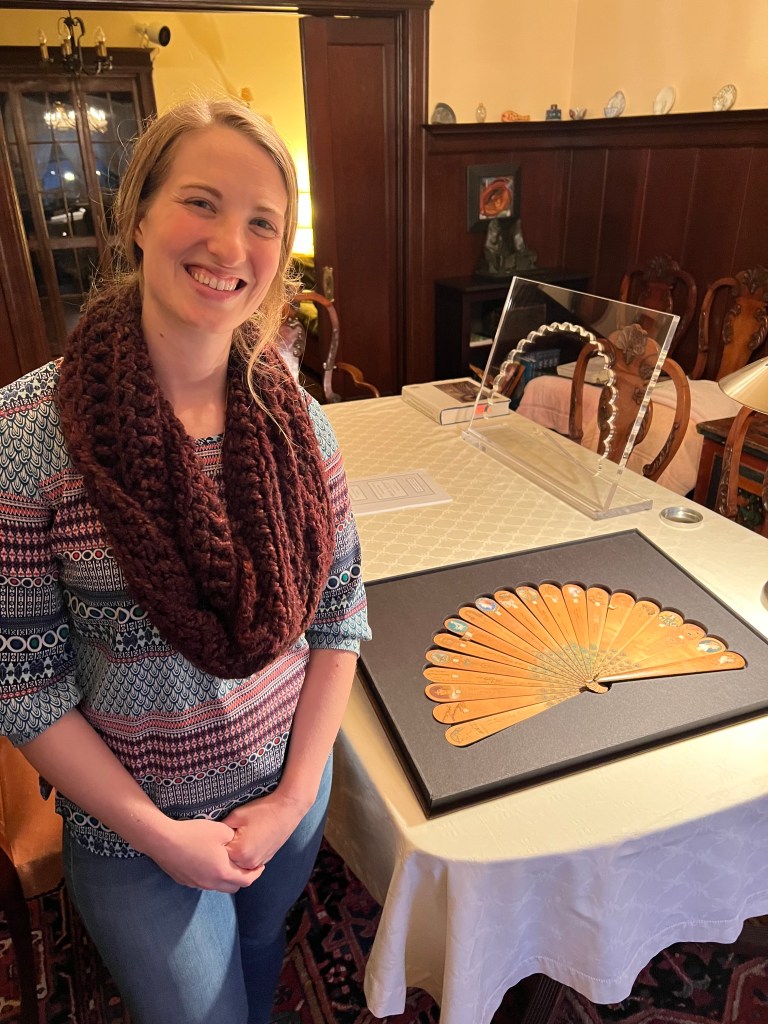
As any scholar of history, material culture, art, etc. knows, one of the best feelings in the world is getting to see the subject of your thesis in person! Due to the generosity of the current owner of the fan, I was able to see it in person over the holidays.
Every Art Historian’s dream is to see the object they’ve researched in person!
A Quick Overview:

What is the Walter Crane Fan:
Adopted from China and Japan, autograph books and fans were immensely popular amongst the ladies of Europe during the late nineteenth century. In fact, ladies would often hound artists, writers and musicians to sign their fan. Using the signatures as a status symbol, ladies of Europe took on this hobby. There was a particular craze for this type of fan in London, where the Crane fan was “mostly” created. (This is with the exception of its sojourns in Paris during the summer of 1895, while in Whistler’s Possession, and potential Manchester.)
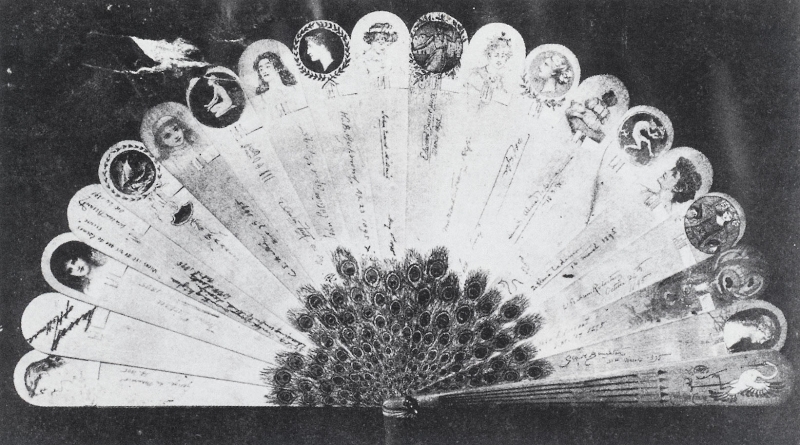
The fan in question was mostly completed between January and November of 1895. Containing the signatures of forty artists, musicians, writers, and public figures, this fan also bears twenty-four sketches or small paintings on the individual fan blades completed by various artists, including those mentioned above. In addition to their signatures, the artists left vignettes representing themselves and their art, music, or written work. Artists featured on the fan include, Frederic Leighton, Edward Burne-Jones, Lawrence Alma-Tadema, Raimundo de Madrazo, James Jacques Tissot, and many more. Most notably, for me, was the inclusion of James McNeil Whistler’s sketch and butterfly signature and John Singer Sargent’s sketch of peacock feathers.
One of the contributors to the fan was English artist and illustrator Walter Crane (1845-1915), for whom the fan is named. Crane most likely provided the final addition to the work. We don’t have a date for Crane’s addition, and it could be much later, as late as 1910. This is because the fan was sold at Sotheby’s and written about in 1910 as containing the Crane signature.
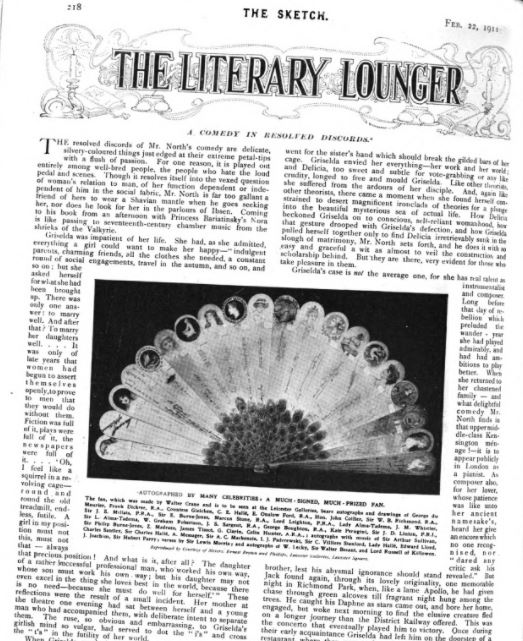
The Fan sold at Sotheby’s in 1910 as belonging to a Lady of Exalted Rank. Since then, It has been featured in David Park Curry’s “James McNeill Whistler at the Freer Gallery of Art,” in 1984 and more recently Robyne Erica Calvert’s, “An Artistic Fan in Victorian Society” in Connecting
Whistler: Essays in Honour of Margaret F. Macdonald from 2010.
York: W.W. Norton & Company, 1984), 207.
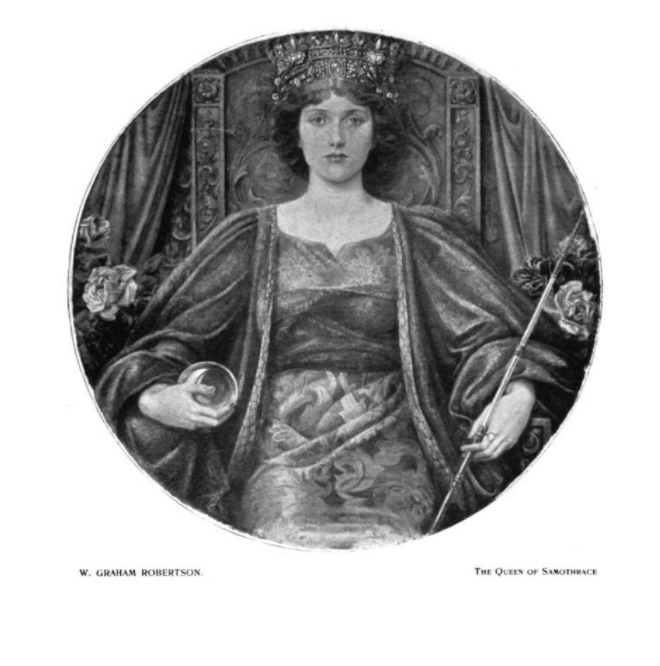
Some of my exciting discoveries included linking the fan sketches to existing paintings. Specifically, I found a reference to W. Graham Roberton’s final painting created after he sketched the fan.
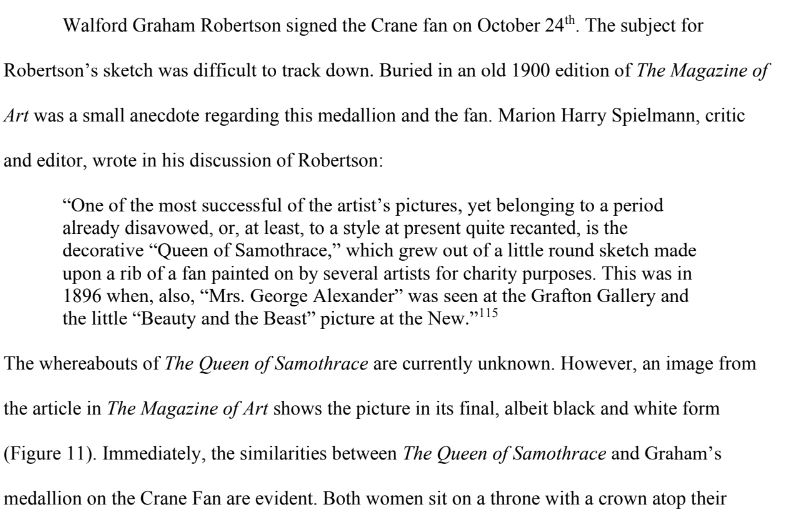
https://digitalcommons.lindenwood.edu/theses/71
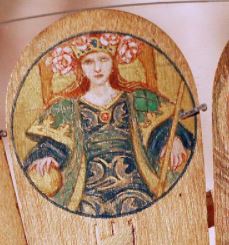
You can read more about the Crane Fan by checking out my thesis here. It was published through Lindenwood University in 2022.
My journey with the Crane Fan:
While at Sweet Briar College and working on my undergraduate thesis, I discovered this fan! I knew I wanted to know more about it. I began researching in 2017 and only completed this thesis, along with my MA degree in 2022.
Over those five years, I was able to speak with Dr. Robyne Calvert. Calvert originally wrote about the fan in Connecting Whistler: Essays in Honour of Margaret F. Macdonald (2010). Dr. Calvert so graciously spoke with me and gave me even more information. Eventually, I got in touch with the current owner of the fan. She was gracious enough to let me come visit and see the fan in person! How wonderful! My dream comes true. Now, I aim to continue research into the “Lady of Exalted Rank” who once owned the fan.
What’s next:
Without giving too much away, there was a third section of my thesis planned. As the thesis development process went on, my thesis began to evolve in scope and that third section fell too far out of that scope. However, it will serve as a backdrop for an article I am working on. But as with all my projects, I have so many and never enough time. So, stay tuned.
Read more about folding fans here. Subscribe to receive my blog posts weekly.
 Caroline Haller Curation